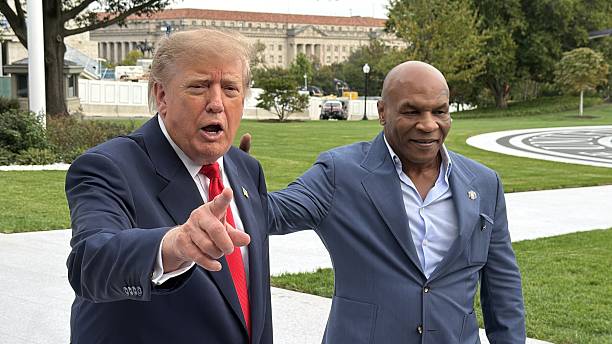
(ThyBlackMan.com) Here in the stretch before the midterms, the baddest man ever to lace up gloves is right where he always seems to end up, planted somewhere in Donald Trump’s corner. No belt on the line, no pay-per-view audience to impress, nothing to sell but presence itself. Iron Mike is grayer than we remember now, a little softer in the face, yet he carries the same thing he always has, that aura of somebody who simply doesn’t flinch. The 47th president made a campaign stop in Syracuse, New York, on October 9 to support Republican gubernatorial candidate Bruce Blakeman, with the election coming November 3. His old heavyweight friend came along for the ride, lending the cause some muscle. At this point, seeing Tyson standing beside Trump is hardly a surprise anymore.
Which leaves a bunch of us in the fall of 2026 scratching our heads over the same riddle Black men in barbershops from here to Shreveport have turned over for a decade. Why does he keep showing up for a figure like that?
You can’t answer it honestly without rewinding almost 40 years, back when both of them were cash machines wearing different uniforms. Through the late 1980s, while Donald stacked casinos along the Atlantic City boardwalk, the champ was demolishing grown men with a ferocity the boxing world had rarely witnessed. Trump Plaza became closely associated with the fighter’s biggest nights, including the famous 1988 showdown with Michael Spinks at the Atlantic City Convention Hall, right beside the hotel. Trump paid a record $11 million site fee to bring that fight to town. Those were sweaty weekend spectacles where big money, celebrity, and real violence all shared the spotlight. One of them needed packed arenas and headlines. The other wanted paydays and a glittering stage. They fed each other, and the bond was built on something older than ideology, which is plain mutual usefulness.
Then came the fall. Indiana, 1992, when Tyson was convicted of raping Desiree Washington, an 18-year-old beauty pageant contestant, and sentenced to six years in prison. The conviction shattered his career and permanently complicated his public legacy. Here’s where the relationship takes another turn, because the casino boss publicly defended him. Trump questioned the verdict and argued that Tyson had been railroaded. He even suggested allowing Tyson to continue fighting and directing some of his earnings toward Washington and other rape victims rather than sending him to prison. None of that changes what Tyson was convicted of doing or diminishes the harm Washington suffered. But from the fighter’s perspective, having a powerful friend defend him during the darkest chapter of his public life may have carried enormous weight. Loyalty like that, offered when a man’s reputation has collapsed, can create a sense of obligation that lasts for decades. Looking at their friendship today, I suspect Tyson has never forgotten who spoke up for him.
Jump to 2015, when a reality-TV blowhard rode an escalator into presidential politics, and guess who stepped up early? The champ offered his blessing, praising Trump’s business background and arguing the country ought to run more like a business where the gig goes to whoever can actually do it. Tyson wasn’t blind to every controversy surrounding his friend, either. He acknowledged that some of Trump’s comments about Latinos were crude, even as he defended the man making them. Critics winced. When Trump celebrated the endorsement during the 2016 Republican primary, Ted Cruz condemned him for embracing the support of a man convicted of rape, while Carly Fiorina questioned what that enthusiasm revealed about Trump’s character. None of that seemed to shake Tyson’s support. He had offered a political argument about business and leadership, sure, but I have always suspected something more personal was operating underneath it. He was vouching for somebody who had vouched for him first.
Push the clock to now and the picture only sharpens. Donald won again in 2024, securing a second, nonconsecutive term, and his political movement has reached into whole lanes of American life, wellness included. Back in February 2026, millions watched the former heavyweight appear in a Super Bowl advertisement for the Make America Healthy Again movement, urging Americans to eat real food instead of loading their bodies with heavily processed junk. The privately funded spot came from the nonprofit MAHA Center and drew on Tyson’s own struggles with unhealthy eating and the loss of his sister. Smart casting, honestly. Who better to preach about surviving your own worst appetites than a guy who once bit off part of a rival’s ear and has spent years trying to make peace with his own complicated history? That advertisement brought him into another corner of Trump’s political orbit, and his appearance in Syracuse this fall offered another reminder of just how long this friendship has endured.
So let me set the real question on the table, the one the headline keeps circling. Is this loyalty, shared values, or honest political agreement?
Strip it down and the policy piece looks thin, at least from where I sit. I’ve listened to this brother talk for 30 years, and not once have I heard him offer some sweeping breakdown of tax brackets, tariffs, or the fine print of Medicaid. Ask about a jab or a left hook and he’ll teach a master class. Raise congressional appropriations and I wouldn’t expect the same enthusiasm. That doesn’t mean Tyson has no political beliefs. His comments about running government like a business tell us he has considered at least some questions of leadership and economic opportunity. But treating his continued support as proof of some deep ideological alignment hands both figures more philosophical credit than the public record earns. There is a difference between believing somebody can lead and embracing every policy that person carries into office.
Values, though, that runs warmer. Each of these characters built an entire life on defiance, on telling polite society precisely where to stick its opinion, on outlasting scandals and setbacks that might have ended somebody else’s public career. Strength, dominance, refusing to surrender, those seem to be the shared scriptures. Two people who have been counted out, laughed at, written off, then found their way back into the spotlight might naturally recognize something familiar in each other. That recognition could explain more than any position paper ever would. Trump sees a former champion who still commands attention when he enters a room. Tyson sees a businessman turned president who has spent decades refusing to retreat when the world turns against him. Neither man has built his public identity around winning everybody’s approval, and that similarity counts for plenty.
Still, I believe loyalty is the engine. Everything else is just trim. When you’ve endured public disgrace and remember that one powerful person defended you while much of the country condemned you, that memory can outlive trophies, outlive presidencies, outlive whatever either of you thinks about the border or the budget. I cannot climb inside Tyson’s head and declare what drives every decision he makes. Nobody outside that friendship can. But watching him stand beside Trump nearly four decades after those Atlantic City nights, I see a man whose allegiance appears rooted in something more enduring than campaign promises. Maybe he agrees with the Republican agenda. Maybe he admires the president’s approach to leadership. My reading is that neither explanation carries quite the same emotional weight as remembering who stood up for him when his own world came crashing down.
Finish story here; Mike Tyson and Donald Trump: A Friendship That Raises Questions for Black Men.
