
1
(ThyBlackMan.com) As America marks its 250th birthday, millions of Americans are celebrating the greatest experiment in self-government the world has ever known. Yet for others, particularly within segments of the African American community, Independence Day remains a reminder of our nation’s original failures rather than its extraordinary progress.
There is no denying our history. Slavery was evil. Jim Crow was unjust. Racism has left scars that are still felt today. These truths deserve to be taught honestly and remembered faithfully.
But history should also be measured by progress. If we refuse to acknowledge how far America has come, we risk creating a narrative that is disconnected from the reality millions of Americans experience every day.
This Independence Day, one photograph spread rapidly across social media. It showed a young Black woman riding a Washington, D.C., Metro train surrounded by masked members of the Patriot Front, a group widely regarded as a white nationalist organization. To many, the image became proof that America is sliding backward into its darkest days.
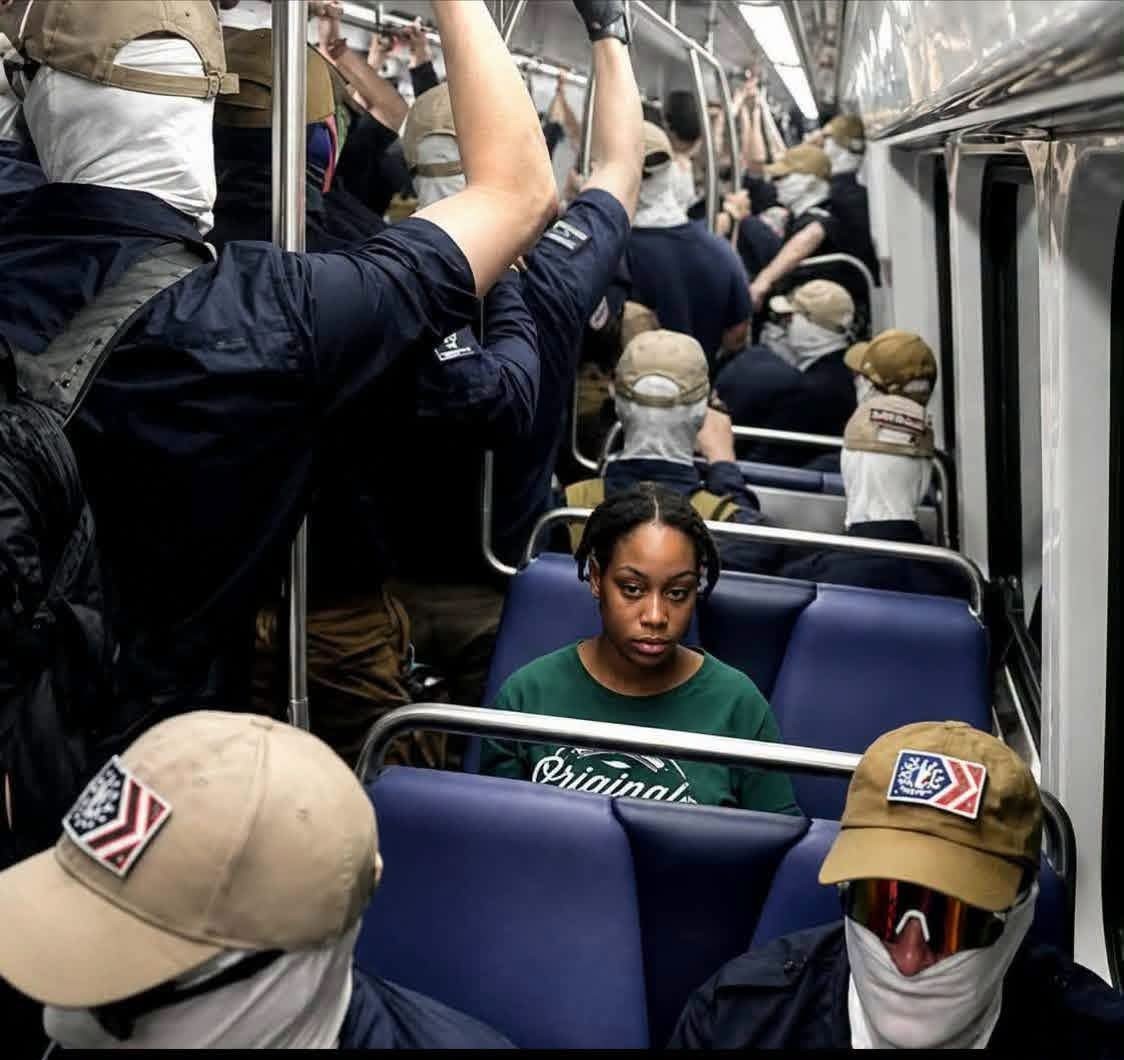
Yet the facts tell a more complicated story.
The young woman completed her ride without being assaulted or threatened. There were no arrests. There was no violence. She safely reached her destination.
That outcome should not surprise us—not because extremist groups deserve praise, but because America in 2026 is not America in 1926 or 1826. We have made tremendous progress. The existence of hateful individuals does not erase the remarkable transformation our country has undergone over the past two and a half centuries.
Now compare that peaceful encounter with another reality that receives far less reflection.
Across America, cities continue to struggle with organized “teen takeovers,” flash mobs, assaults, robberies, and acts of violence that leave innocent people injured and communities living in fear. Too often, these incidents are dismissed as isolated events when they are becoming increasingly familiar to residents of many urban neighborhoods.
The contrast is striking.
One widely shared image became a symbol of fear because of who was present, despite no violence occurring. Meanwhile, actual acts of violence occurring in our own communities often receive less attention than the symbolism attached to a photograph.
That should concern all of us.
As African Americans, we should certainly continue confronting racism wherever it exists. We should reject hatred in every form. But we must also have the courage to confront the challenges within our own communities. Public safety, family stability, educational achievement, and respect for law and order are not partisan values—they are essential ingredients for thriving neighborhoods.
If we want the next generation to inherit a stronger America, we cannot build our future solely by looking backward. We must also look inward.
America’s founders understood that the nation would never be perfect. That is why the Constitution speaks of forming “a more perfect Union.” The goal was continual improvement, not instant perfection.
For 250 years, America has moved steadily toward expanding liberty and opportunity. The descendants of enslaved people have become governors, members of Congress, military leaders, entrepreneurs, judges, and even President of the United States. Those accomplishments do not erase our painful history, but they demonstrate that our history is not the final chapter.
Progress deserves recognition.
The Metro photograph, viewed through another lens, tells a different story than many assumed. It shows a Black woman traveling peacefully through the nation’s capital, surrounded by people whose views many Americans reject, yet arriving safely. That image, while unsettling, also reflects a country that has changed dramatically from generations past.
America still has work to do. Every nation does. But acknowledging progress is not an act of denial—it is an act of honesty.
As we celebrate America’s 250th anniversary, let us reject both hatred and hopelessness. Let us teach our children the full story of our country: its failures, its triumphs, its struggles, and its victories. Let us demand safer streets, stronger families, better schools, and communities where every child—regardless of race or neighborhood—has the opportunity to succeed.
Patriotism does not require believing America is perfect. It requires believing America is worth improving.
At 250 years old, our nation remains unfinished. That is not a weakness. It is the enduring promise of the American experiment—and one worth celebrating.
Staff Writer; Christopher Anderson
This brother is a third-generation Baltimorean, a father of three, a U.S. Coast Guard veteran, and a lifelong community advocate. He is currently Chairman of the Maryland Black Republican Council & a member of the Baltimore City Republican Central Committee. He has run for Congress and the Baltimore City Council.
