
(ThyBlackMan.com) I have heard this debate in barbershops, at cookouts, around card tables, and in those long talks where somebody swears they are not arguing while clearly arguing. Put Michael Jackson and James Brown in the same sentence and you are going to wake up somebody’s opinion. One person will say Michael was the greatest entertainer God ever placed on a stage. Another will say James Brown was the man who taught half of modern music how to walk, sweat, shout, stop, start, and hit that first beat like it owed him money.
I understand both sides. I really do.
Michael Jackson had the bigger fame. I do not see how anybody can sit there with a straight face and deny that. Michael became something beyond a singer. He became a world figure. A child in a small town knew him. A dancer overseas knew him. A grandmother who did not buy pop albums still knew that glove, that hat, that moonwalk, and that little kick before he slid across the floor. He was one of those rare people who did not need an introduction after a certain point. The room knew before the announcer finished talking.
But fame is not the same as influence. That is where the debate gets good.
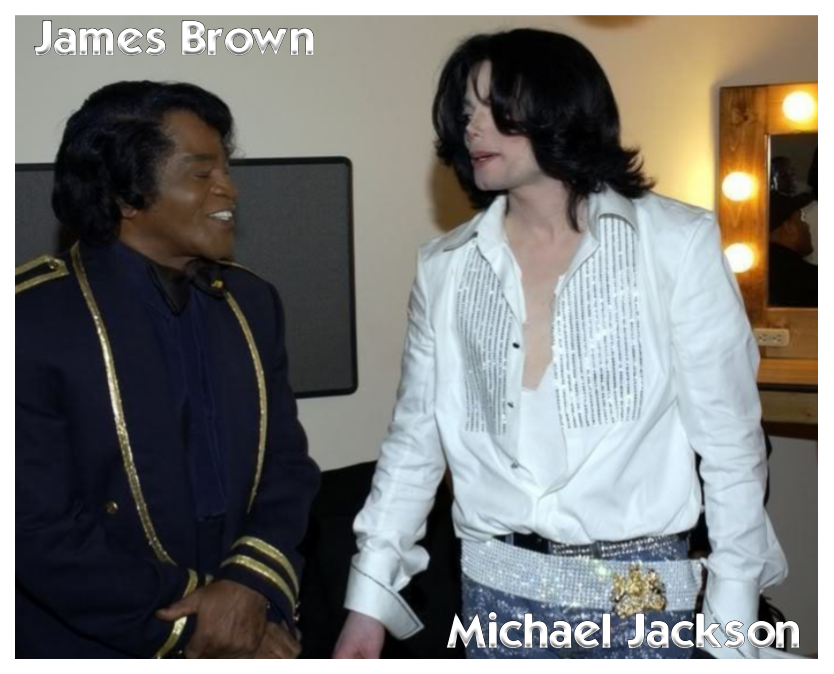
Fame is everybody knowing your name. Influence is somebody moving like you, singing like you, building a beat from you, or borrowing your stage language fifty years after your first big moment. Fame gets loud. Influence gets buried deep. Fame makes headlines. Influence shows up in somebody else’s song, somebody else’s footwork, somebody else’s band, somebody else’s drum break, and sometimes folks do not even realize where it came from.
That is why James Brown is hard to move out of the way.
Before Michael became the King of Pop, James Brown had already made rhythm the main character. You can hear it in “Papa’s Got A Brand New Bag.” You can hear it in “I Got You. (I Feel Good)” You can really hear it in “Cold Sweat.” Those songs were not just records playing on the radio. They were lessons. James was showing everybody that a song did not have to float on melody alone. The beat could talk. The bass could talk. The horns could talk. A grunt could be part of the arrangement. A scream could land right where a snare drum should have been.
That was not by accident either. James Brown knew exactly what he was doing. Folks sometimes act like he was just wild energy in a suit, but that brother was disciplined. He ran that band like a man running a business and a church choir at the same time. If the drummer missed something, James heard it. If the horn section came in lazy, James caught it. If the groove was not right, nobody on that stage got to relax. He might have been sweating through his clothes, sliding across the floor, and dropping to his knees, but do not mistake movement for chaos. James Brown was control dressed up as fire.
Now let us walk through the eras a little bit, because that is where this debate gets even richer.
In the 1970s, James Brown was already a grown man’s storm. “Get Up I Feel Like Being A Sex Machine” was not built like a regular song. It felt like a command. “Super Bad” had so much strut in it you could almost see somebody stepping out of a Cadillac in a sharp coat. “Soul Power” sounded like Black pride with horns behind it. “Make It Funky” did exactly what the title said. No mystery. No begging. Just make the thing funky and let the people catch up.
Then there was “The Payback.” Lord have mercy, that record still sounds like trouble walking slow. Not foolish trouble. Not reckless trouble. I mean the kind of trouble that comes from a man who has been wronged and is not asking permission to feel what he feels. That groove is patient. Mean. Grown. It does not rush because it knows it already owns the room. “Funky President” had a political edge to it, but it still moved. “Papa Don’t Take No Mess” sounded like somebody’s uncle who did not have to explain himself twice.
And I cannot talk about James Brown’s influence without giving proper respect to “Say It Loud, I’m Black And I’m Proud.” That song was bigger than radio. It helped Black folks say out loud what society kept trying to beat down, hide, and make us feel ashamed of. James Brown gave pride a rhythm. He made Blackness sound bold, strong, and public at a time when many of our people needed to hear somebody say it without fear. That record was not just funk. That was identity. That was a whole people straightening their backs, lifting their heads, and understanding that being Black was not something to apologize for. Michael Jackson became the bigger global superstar, but James Brown gave Black people an anthem that helped us embrace ourselves.
At the same time, Michael was coming through the 70s in another way. With the Jackson 5, he had already touched America with “ABC,” “The Love You Save,” “I’ll Be There,” and “Never Can Say Goodbye.” That little boy could sing pain before he had lived enough life to explain it. That was the mystery of Michael early on. His voice was young, but it carried something older. You could hear innocence and heartbreak standing beside each other.
By the late 70s, Michael was no longer just the little brother with the big voice. “Don’t Stop Til You Get Enough” announced that he was stepping into his own grown sound. “Rock With You” was smooth enough to make a whole room feel like the lights had dimmed. “Off The Wall” had joy in it. Not forced joy either. It sounded like release. That album was the door opening before the whole world rushed in.
Still, even then, you could see James Brown’s shadow. Not in a cheap copycat way. Michael was too gifted for that. But Michael studied the great ones, and James was one of the great ones he studied closely. The sharp stops, the quick feet, the body control, the way a dancer could attack silence between beats, all of that had roots. Michael polished it until it looked like magic. James gave it to you like sweat flying off a man who had something to prove.
Then the 1980s came, and Michael Jackson took over the planet.
“Billie Jean” was more than a hit song. That record felt like a door opening into a new kind of stardom. The bassline was simple, but it had a walk to it. When Michael performed it and gave the world that moonwalk, everything changed. “Beat It” crossed into rock without leaving soul behind. “Thriller” turned a music video into an event. People did not just watch it. They gathered for it. “Wanna Be Startin Somethin” had that restless energy that could still fill a dance floor. Then came “Bad,” “The Way You Make Me Feel,” “Smooth Criminal,” “Dirty Diana,” and “Man In The Mirror.”
That run was not normal. That was a man standing in the middle of pop culture and telling everybody else to move around him.
Michael understood the screen better than most entertainers of that time. He knew the pause mattered. He knew the entrance mattered. He knew the clothes, the lighting, the dancers, and the camera angle all worked together. After Michael, big pop performance could not be lazy anymore. If you wanted to be that kind of star, you had to bring a full show. You could not just sing into the microphone and expect folks to call it legendary.
James Brown in the 80s was not sitting at the same table commercially. He was not the young ruler anymore. But that does not mean he was gone. “Living In America” put him back in front of a new crowd, and even if that record had a shinier 80s sound, it still reminded people who he was. The interesting part is that while Michael was dominating the decade on television, James Brown was living inside the music from underneath. Hip hop was rising, and those producers kept digging into James Brown’s catalog like they had found gold in the backyard.
That is where influence starts outlasting chart position.
By the 1990s, Michael was still huge. “Black Or White” was a worldwide moment. “Remember The Time” gave us that smooth groove and one of his best videos. “Jam” had a harder edge. “In The Closet” was grown and tense. “Scream” with Janet sounded like two famous people tired of being chewed up by the machine. “They Don’t Care About Us” had anger in it. “Earth Song” was dramatic, maybe too dramatic for some people, but it showed Michael still wanted to make music that felt big. “You Are Not Alone” proved he could still stand inside a ballad and make the world listen.
But the 90s also showed just how deep James Brown’s reach had gone. Hip hop was not just borrowing from him here and there. It was building with pieces of him. Producers used his drum breaks, his grunts, his grooves, his screams, his band hits, his whole sense of rhythm. Public Enemy, Eric B. and Rakim, Big Daddy Kane, LL Cool J, Heavy D, N.W.A, and plenty more moved through music that had James Brown somewhere in the walls. A young person could be riding around listening to rap and still be hearing James without knowing it.
That is the kind of influence you cannot measure by screams at a concert.
Michael influenced performers who wanted to become stars. James influenced the very structure of the music they were standing on. Michael made you ask how to create a moment. James made you ask how to make the body move.
By the 2000s, things had changed again. Michael’s public life had become heavy, and the industry had shifted. Still, “You Rock My World” showed he could still glide through a groove. “Butterflies” was beautiful and does not get enough respect. “Break Of Dawn” had a late night R&B feel that grown folks could appreciate. “Whatever Happens” had a different kind of maturity. The Invincible album did not rule the world like Thriller or Bad, but that does not mean the music had no value. People were sometimes so caught up in the noise around Michael that they stopped listening fairly.
Even with all that noise around him, Michael’s fingerprints were still all over the place. You could see it in Usher’s footwork, Chris Brown’s sharp dance breaks, Ginuwine’s smoothness, Ne Yo’s stage style, and even Justin Timberlake trying to carry that pop and R&B mix. None of them were Michael, but you could tell they grew up in the world he helped build. The hat tilt, the pause before a move, the dancers lined up behind the star, the way a man could walk on stage and already look like a performance before he sang one word, Michael helped make that normal.
James Brown in the 2000s was an elder by then, but he still did not feel small. He was already permanent. Young artists did not need him to have a new radio hit to prove he mattered. The samples had already proved it. The dancers had already proved it. The funk bands had already proved it. The rappers had already proved it. Even the way people talked about stage presence had a little James Brown in it. When folks say somebody “worked” the stage, that road runs through James.
Coming from the South, I hear James Brown in a particular way. He sounds like sweat, church, tobacco roads, juke joints, shiny shoes, hard times, and a man who learned how to turn pressure into command. He was not always pretty. He was not supposed to be. He had that raw thing in him. That thing older folks recognize when somebody has had to fight for every inch. His music did not ask you to sit still and admire it. It grabbed you by the shoulders.
Michael was different. Michael gave us wonder. He gave us fantasy. He gave us polish. He could sound soft on “Human Nature,” wounded on “She’s Out Of My Life,” bold on “Bad,” lonely on “Stranger In Moscow,” and almost spiritual on “Man In The Mirror.” People who reduce Michael to the glove and moonwalk are not listening carefully enough. That man had feeling in his voice. Real feeling. He could make a line sound like a secret.
James Brown carried a different kind of weight, plain and simple. “Please, Please, Please” sounded like a man begging with his whole chest, not just singing into a microphone. “It’s A Man’s Man’s Man’s World” had all that old school pride, pain, ego, and hurt sitting inside it at the same time. But “Say It Loud, I’m Black And I’m Proud” was something else. That one was bigger than a hit record. For a lot of Black folks, that song helped put some steel in the spine. It came through the speakers saying what many of our people needed to hear out loud. You did not have to shrink. You did not have to be ashamed. You did not have to explain your Blackness to anybody. James Brown could entertain the room, but he could also remind you to stand up straighter before the song was over.
So where do I land?
Michael Jackson was bigger. No question. Bigger fame. Bigger global reach. Bigger videos. Bigger pop moments. Bigger worldwide image. At his peak, Michael was not just competing with other singers. He was competing with the idea of fame itself.
But James Brown may have been deeper. He changed the groove. He changed the band. He changed how rhythm worked in Black popular music. He helped shape funk, and funk helped shape hip hop, R&B, dance music, and so much more. He influenced Michael too, and that matters in this conversation. If the man you are comparing him to studied him, then you cannot brush him aside.
I look at it like this. Michael Jackson was the tallest tree in the yard. Everybody could see him from the road. James Brown was part of the root system under the ground. You might not always see roots, but you better believe the tree needs them.
Michael made the world watch.
James made the world move.
And where I come from, brother, movement tells the truth.
