
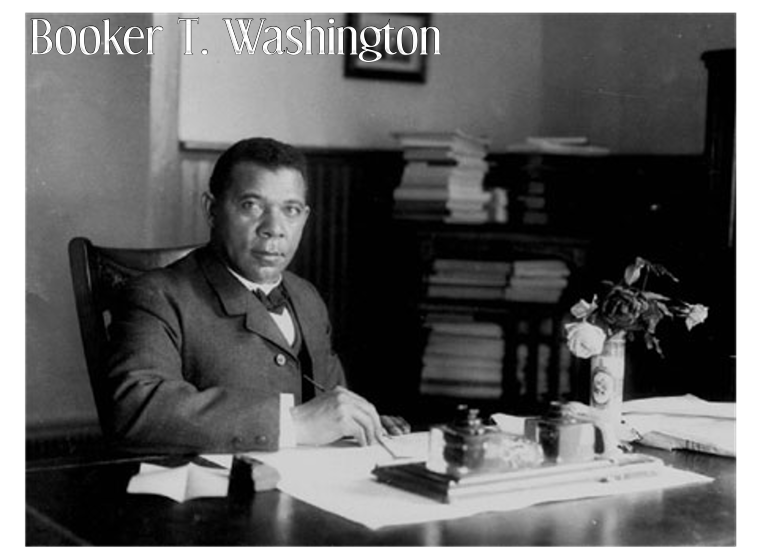
(ThyBlackMan.com) American memory rarely allows complicated men to stay complicated, and few figures in our history have been flattened more thoroughly than the founding principal of Tuskegee Institute.
I came up hearing two versions of Booker T. Washington, and neither one sounded like a human being. In my grandmother’s front room, his portrait hung near the mantel like a distant uncle who had done well for himself. Over at my cousin’s place, the college students had another name for him, and it was not affectionate. Sellout. Handkerchief head. The man who swapped a ballot for a bricklaying certificate.
Both houses argued over the same photograph and saw entirely different faces.
Here is the part nobody enjoys sitting with. He entered this world as property, in Virginia, back in 1856. Freedom arrived while he was still small, and by the time he reached manhood the nation had already started clawing back what it briefly extended. Reconstruction fell apart. Federal troops packed up. Men who lost the war were rewriting the peace with rope and legislation, and they were winning that fight. That was his room. Not a lecture hall. No courtroom up in the capital either. Alabama in the 1880s, where a colored fellow who spoke out of turn might be found swinging from a limb before Sunday service.
Start there, or do not bother starting.
What he assembled in that environment deserves plain description. His school opened in 1881 inside a one-room shanty provided near Butler Chapel AME Zion Church, with about thirty pupils and no campus of its own. In the years that followed, students dug the clay, fired their own bricks, raised campus buildings, then sold surplus bricks to white neighbors who needed building material. Nobody handed that operation a finished campus. It got put up by hand, in a county where the sheriff was nobody’s friend.
Now, about the caution.
Critics then and since have described his public posture as bowing. Consider the physics of his position instead. He ran a Negro institution in the heart of the Black Belt, increasingly financed by Northern philanthropists and still dependent on an Alabama political order that could cut support, obstruct its work, or turn the state against it. One inflammatory sentence from him could threaten funding, invite political retaliation, or endanger the people working and studying there. Teachers were run off, schools were attacked, and Black education was routinely treated as a challenge to white authority. His caution was not a personality defect. It amounted to insurance on a property full of somebody’s children.
None of which excuses September 1895 in Atlanta.
Frederick Douglass had died that February, leaving a vacancy at the top of colored leadership that everybody felt. Before a largely white, racially segregated audience at the Cotton States Exposition, he told the country that agitating over social equality was foolishness, that in purely social matters we could be as separate as fingers on a hand. Cast down your bucket where you are. White newspapers crowned him spokesman for Black America practically overnight, and he wore that crown for twenty years without much complaint.
Understand what actually happened in those minutes. He did not merely make private peace with segregation. What he handed segregation was an endorsement, delivered by the most prominent Black spokesman in the country, quotable forever afterward by every governor and editor hunting for justification while the door swung shut.
Celebrity of that grade converts into resources, and he spent his shrewdly. The National Negro Business League followed in 1900, knitting grocers and barbers and undertakers into something resembling a bloc. Money arrived from industrialists who would never have written a check to an agitator.
Notice, though, that the care he took bought him no safety at all. October 1901, he ate supper at the executive mansion with Theodore Roosevelt, and Southern editors lost their minds for weeks over a shared plate of food. Politeness protects nobody. Several who had applauded Atlanta now wanted him horsewhipped.
Du Bois named the trade correctly in 1903. Swapping political power, civil rights, and higher learning for vocational training, economic advancement, and white goodwill could only pay off if white America honored its end, and white America never had the slightest intention. Lynching remained endemic. Voting collapsed throughout the South. Talented youngsters got steered toward the anvil and the plow while medicine, law, and politics stayed locked. Northern philanthropists and Southern politicians found something to agree on for once, which should have been the warning nobody heeded.
Then came the machinery, which did its own damage. Friendly newspapers received subsidies and returned the favor in print. Presidents consulted him about federal appointments, meaning ambitious men learned that his blessing could help open a door and his opposition could close one. When William Monroe Trotter heckled him in Boston that same summer, the meeting descended into chaos, Trotter was arrested, and he later served thirty days for disturbing the peace. Washington’s network monitored his opponents, subsidized friendly newspapers, invested in publications willing to attack his critics, and sometimes pressured publishers or printers to deny those critics a platform. A leader who deserved honest disagreement had constructed a system where disagreement carried a price, and that is no longer strategy. That is a boss guarding territory.
Even so, he kept a second set of books. Working through intermediaries and confidential correspondence, he bankrolled legal challenges he could never claim publicly. He secretly supported voting rights litigation, attacks on the exclusion of Black citizens from juries, and the broader legal campaign against Alabama’s system of coerced labor. That campaign culminated in decisions including Bailey v. Alabama, the 1911 Supreme Court ruling that struck down Alabama’s peonage law under the Thirteenth Amendment. Historians pulled that paper trail out of his files decades after the funeral. So the great accommodationist was quietly paying attorneys to sue the very people he flattered from a stage.
His final stretch produced the largest thing he ever touched. Around 1912 he talked Julius Rosenwald into a partnership that began with six Alabama schools. It eventually helped build nearly five thousand schoolhouses across the South, most of them completed after his death. Black communities supplied much of the money, land, materials, and labor themselves. Generations of children learned their letters because of it, including plenty who later marched.
By the time they lowered him into the ground in 1915, his campus held about a hundred structures and fifteen hundred enrolled students. Roughly two hundred faculty members drew a salary there, and the endowment approached two million dollars, making Tuskegee one of the largest and best funded Black educational institutions in the country.
Still, I notice something about the gentlemen who wrote the indictment. Some of his most prominent critics composed it from Boston, from Atlanta’s university district, and from New York. Distance from Macon County is not a moral failing. It remains worth remembering when we sit down to grade the courage of somebody teaching inside it.
So where does the ledger land? He was a survivor who confused survival with philosophy. His method fit one decade and one latitude, and he kept applying it long after conditions shifted and younger folks had earned the right to try something louder. Refusing to step aside was his genuine failure, larger than any single speech. Older leaders rarely surrender the microphone gracefully.
We repeat this argument every generation, only the names rotate. Somebody works inside the institution while somebody else hammers on it from outside, and pretty soon we are questioning each other’s souls instead of debating tactics. Our people needed both hands working then. We need both hands working now. That man was not a traitor and he was not a deliverer. He was gifted, ambitious, frightened, and calculating, doing arithmetic under conditions I would not wish on my worst enemy, and he got several of the sums wrong. Such a verdict is harder to chant at a rally. It happens to be accurate, though, and accuracy has always served us better than comfort.
Staff Writer; L.L. McKenna
Politics explained through the lens of justice and equity. Offering perspective that informs, challenges, and empowers.
One can contact this brother at; LLMcKenna@ThyBlackMan.com.
