
(ThyBlackMan.com) Marco Rubio and JD Vance have a lot in common. They are both high-ranking members of the Trump administration who aspire to be president one day.
In addition to both of them serving in the U.S. Senate, Rubio and Vance say they are guided by their Catholic faith. The common denominator running through them is political expediency. Political expediency, in this case, is the central force driving the behavior and actions of two leaders who at times compromise moral and political principles in exchange for immediate power, ambition and influence.
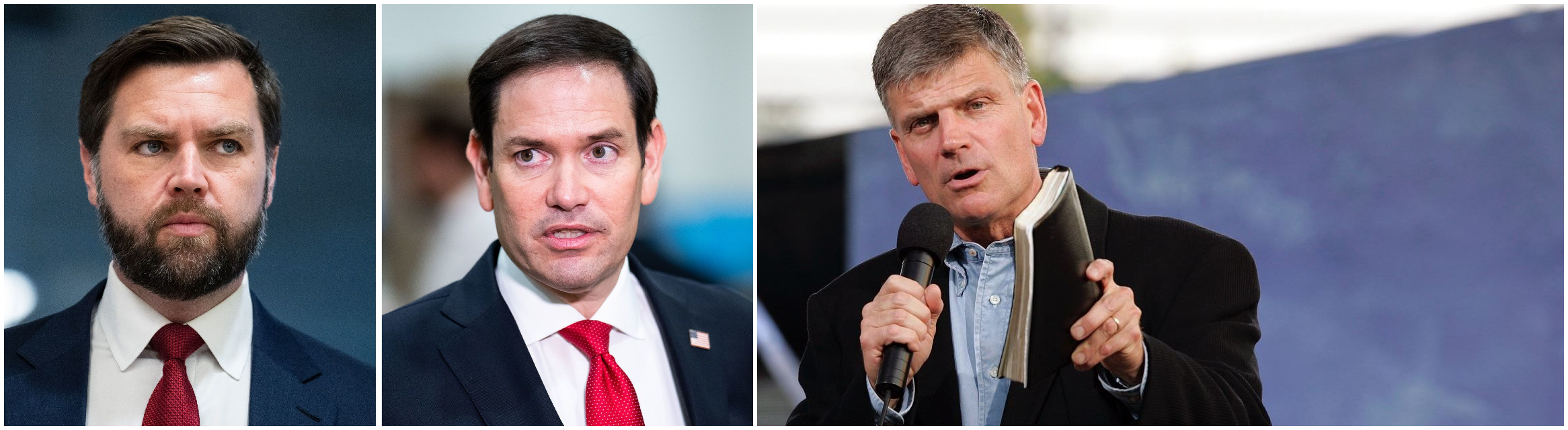
Both Rubio and Vance made the decision that it was in their political best interests and advantage to move away from being harsh critics of Donald Trump to becoming staunch allies in order to remain in Trump’s good graces. In a 2016 interview while promoting his book “Hillbilly Elegy,” Vance called himself “a Never Trump guy” and said of the soon-to-be-president, “I never liked him.” He told NPR the same year, “I can’t stomach Trump.” He wrote an op-ed for The New York Times titled: “Mr. Trump Is Unfit for Our Nation’s Highest Office.” Today, JD Vance is Trump’s vice president.
On the other hand, during the 2016 campaign for the Republican nomination, Rubio called Trump a “con artist” and “the most vulgar person to ever aspire to the presidency.” Now, Rubio is the current Secretary of State in the Trump Administration.
While Evangelist Franklin Graham was never a U.S. Senator having the goal of becoming president, he shows how powerful religious leaders do not have to be politicians to be driven by ethical compromise and political expediency. Graham serves as President and CEO of the organization, Samaritan’s Purse. According to its website, Samaritan’s Purse has met the needs of poor, sick and suffering people by providing food, medical care and other assistance in more than 170 countries. The expressed mission of Samaritan’s Purse is to follow the example of Christ by helping those in need and proclaiming the hope of the Gospel.
Franklin Graham, the son of the famed evangelist Billy Graham, has always been one of Trump’s most loyal religious allies and defenders. He frequently provides public support by mobilizing evangelical voters during both of Trump’s presidential campaigns. Speaking at the Conservative Political Action Conference (CPAC) last month, Graham urged MAGA world to end their infighting and rally around the president and the GOP at the next midterm elections. Therefore, should we be surprised when Graham took to social media to defend Trump’s controversial post depicting himself as a Christ-like figure?
“Franklin Graham of all people, who is frequently at the WH (White House) and with Trump should be leading Trump to be a Christian, NOT telling other Christians that Trump did nothing wrong when he committed blasphemy,” wrote former Trump ally Marjorie Taylor Greene. The former congresswoman was right to expose Franklin Graham. He is not the president’s spiritual leader and advisor in the true sense, but rather a political “kingmaker”. When Christian leaders act as “kingmakers”, they leverage their spiritual authority to mobilize voting blocs, endorse candidates, fulfill cultural goals and shape national policy.
Donald Trump would not be occupying the White House a second time without the support from certain Christian leaders fulfilling their role as political kingmakers. The “kingmaker” will address political topics like abortion and religious liberty by framing them as spiritual battles that require voting for specific candidates. The political realty sees evangelicals getting everything they want despite having a president whose actions contradict Christian moral values.
Franklin Graham is in a unique situation when it comes to fighting poverty. Persistent poverty is a form of social oppression. When dealing with the poor, there is a two-track approach: charity and justice. Charity deals with the symptoms by providing direct services such as food, clothing, medicine and shelter. On the other hand, justice is directed at the root causes behind poverty. It deals with confronting the systemic barriers by promoting social changes in institutions and government laws and policies. Poverty persists because entrenched policies and systemic barriers lock people in, and only legislative action can dismantle those root causes.
Why do Christian leaders like Franklin Graham fight for religious liberty and not fight for economic justice and liberty for the poor through effective legislative engagement? Graham excels at charity, but abstains from the political work required to change the underlying systems of poverty despite having direct access and influence with those in high levels of government.
Graham’s organization addresses the immediate needs by providing food and medicine, yet it leaves the machinery of poverty intact. Continuing to treat the symptoms without confronting root causes such as the ever-widening pay gap between the rich and the poor only entrenches social oppression. A Christian leader cannot simultaneously be a “kingmaker” within a certain power structure and be a genuine advocate for justice that requires the dismantling of the very same power structure.
When Sen. Bernie Sanders speaks out against the one percent, it is a path that confronts the Donald Trumps and Elon Musks of the world. It is a path that Franklin Graham and others are unwilling to take. This selective compassion – addressing charity but ignoring justice – is disingenuous in the same manner of being pro-life on abortion and not on gun control.
Trump will eventually go away in time. Therefore, our focus should first be on the new wave of Trump wannabes who will do anything for political expediency, and secondly on the “kingmakers” who would gladly put them in power.
Written by David W. Marshall
Official website; https://davidwmarshallauthor.com/
One may purchase his book, which is titled;
