
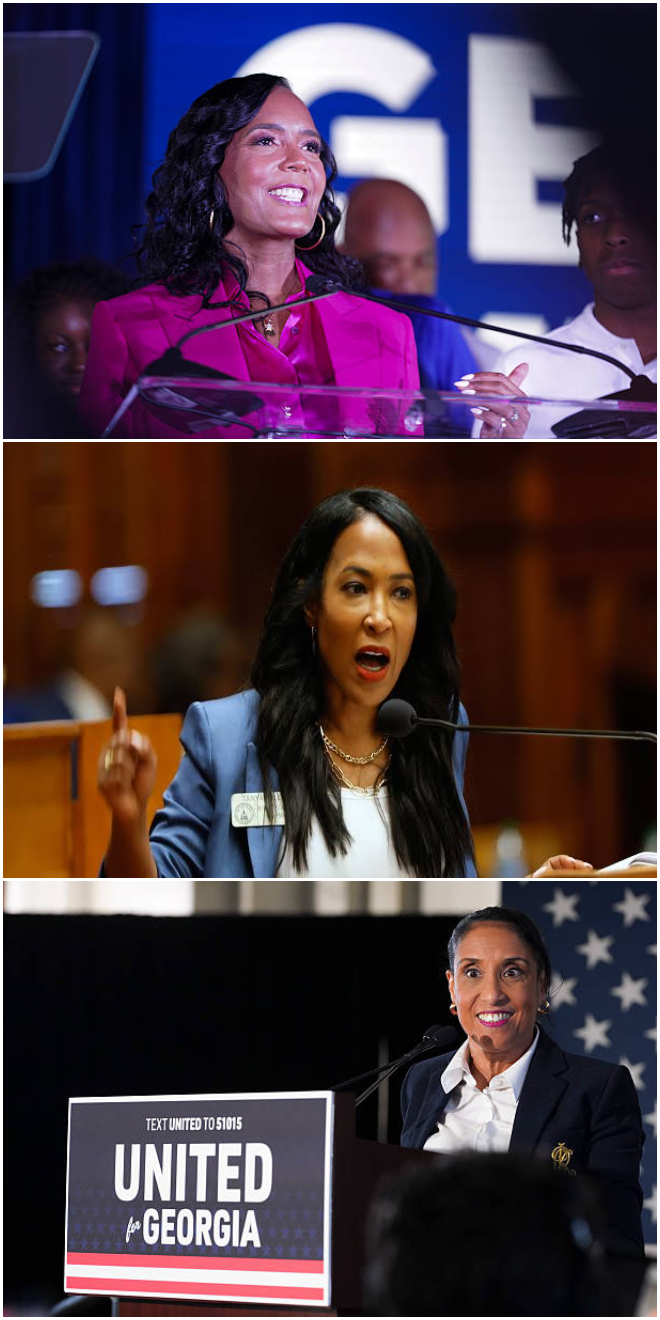
(ThyBlackMan.com) They organized. They mobilized. They led. They delivered. And now, with Keisha Lance Bottoms as Georgia’s Governor-elect, Black women are no longer standing in the background of history. They’re standing at the altar. The bridesmaids have become the brides. This moment is bigger than one election and bigger than one woman. With Keisha Lance Bottoms elected Governor of Georgia, a political ceiling has shattered. She is not standing alone. Tanya Miller, Penny Brown Reynolds, Lydia Powell, Keisha Waites, Nikki Porcher, Shelia Edwards, Lucy McBath, Nikema Williams, and Jasmine Clark are part of a larger story unfolding across America. The women who organized the votes are now receiving them. The women who helped secure political victories are now becoming the public faces of those wins. The bridesmaids have become the brides. This is more than representation. It is a transfer of trust, authority, and power. History did not suddenly discover Black women’s leadership. It finally stopped ignoring it.
America loves the strength of Black women. It just hasn’t always loved Black women. For centuries, Black women have been asked to carry more, endure more, sacrifice more, and forgive more, all while being judged more harshly than almost anyone else. From slavery to the present, stereotypes have painted them as less feminine, less deserving of protection, overly aggressive, hypersexual, and somehow built to withstand endless hardship. Those lies had a purpose: to excuse unequal treatment. What is remarkable is not that Black women persisted despite these barriers. What is remarkable is that they succeeded while carrying them. Too often, society has mistaken Black women’s survival skills for personality traits. Determination became aggression. Confidence became arrogance. Leadership became intimidation. Independence became hostility. Speaking the truth became “difficult.” The reality is that many of the qualities criticized in Black women are the very same qualities celebrated in others. For generations, America has depended on Black women to save institutions, communities, families, movements, and even democracy itself. Yet it has often hesitated to trust them with the same power they helped others achieve. Maybe the greatest misunderstanding in American history is this: Black women’s strength was never the problem. America’s discomfort with it was.
Have we finally begun to see Black women? Not just their beauty, but their brilliance. Not just their appearance, but their intellect. Not just their strength, but their humanity. For centuries, Black women have been forced to navigate a society that often denied them the fullness of their beauty because they did not fit Eurocentric definitions of what was considered desirable, feminine, worthy, or valuable. Their features were questioned. Their voices were dismissed. Their contributions were overlooked. Their sacrifices were expected. Yet despite those barriers, Black women continued to build, lead, nurture, innovate, organize, and transform communities, often without the recognition they deserved. Perhaps the greater question is not whether Black women are finally being seen. The question is why it took so long. Throughout this election cycle, Black media played a critical role in portraying Black women in their full humanity: as leaders, thinkers, visionaries, mothers, professionals, advocates, and agents of change. It provided a counter-narrative to stereotypes that have persisted for generations and reminded America of a truth Black communities have always known.
Black women are not one-dimensional. They are beautiful in mind, spirit, soul, and purpose. If we want future generations to inherit a more honest understanding of Black women, our support for positive, authentic Black media cannot be occasional. It must be intentional. Because representation is not just about visibility. It is about who gets to tell the story. And for far too long, Black women have had their stories told by everyone except themselves.
As Black women continue to make history, their success does more than fill offices, boardrooms, and leadership positions. It forces America to confront old assumptions, challenge outdated narratives, and reconsider who it believes is worthy of power, influence, and trust. Every barrier a Black woman breaks creates a wider path for those who follow. Every election won, business launched, hospital led, classroom transformed, and policy shaped chips away at stereotypes built over centuries. Black women are not simply participating in the future. They are helping define it. From business and entrepreneurship to healthcare, education, politics, and public service, Black women continue to demonstrate that excellence is not the exception. It is the expectation.
In a perfect society, achievement would be celebrated without qualification. Leadership would be embraced without suspicion. Success would not be viewed as a threat. But history teaches us that progress often makes those invested in the status quo uncomfortable. When historically excluded people rise, some mistakenly see equality as a loss. When power becomes more inclusive, some perceive it as displacement. Yet Black women have never allowed resistance to define their destiny. They have turned obstacles into opportunities, setbacks into comebacks, and barriers into bridges. And this time, they will not stand alone. Black men must do more than applaud Black women’s success. We must actively protect, support, and nurture it. We must pray for them, advocate for them, encourage them, defend them when they are unfairly attacked, and celebrate them while they are here, not just after history has validated what we should have recognized all along. For too long, Black women have carried the weight of communities, movements, institutions, and families without receiving the same level of support they so freely gave to others. That must change.
The rise of Black women is not a threat to Black men. It is a testament to what is possible when a people rise together. The true measure of progress will not be how many Black women break glass ceilings. It will be how many ceilings disappear because an entire community decided that Black women should never have had to fight through them alone.
The future belongs to those bold enough to imagine it, courageous enough to pursue it, and committed enough to build it. Black women have already proven they are all three. The question now is whether the rest of us will have the wisdom, humility, and courage to stand beside them.
The story of Black women in America has never been one of waiting to be chosen. It has always been a story of rising despite being overlooked, leading despite being doubted, and believing despite being discouraged. Today, we are witnessing more than electoral victories. We are witnessing the unfolding of a promise for which generations fought, prayed, sacrificed, and persevered. The rise of Black women is not a moment. It is a movement. It is a reminder that history bends when courage refuses to break. As Black women continue to ascend, may we not only celebrate their victories but also honor their humanity, protect their peace, amplify their voices, and support their leadership. The bridesmaids have become the brides, but the greater story is that Black women were always worthy of standing at the altar of opportunity, influence, and power. America did not create their greatness. It is finally beginning to recognize it.
Finish story here; From Bridesmaids to Brides: Black Women Step into Their Moment of Power.
