
(ThyBlackMan.com) The sight is so commonplace on Los Angeles streets that it no longer rates more than a passing glance. That is a homeless man or woman sleeping on a sidewalk. What’s even more commonplace is that people casually walk by or more likely around them without more than a causal glance.
I watched that happen again recently with a homeless man sprawled on the concrete at a bus stop in the Crenshaw district of Los Angeles. As is often the case, he was clad in tattered clothes, and all his earthly possessions, a blanket, and some cans and other food items were stacked up nearby. I called the L.A. mayors emergency crisis team and implored them to send aid to the man.
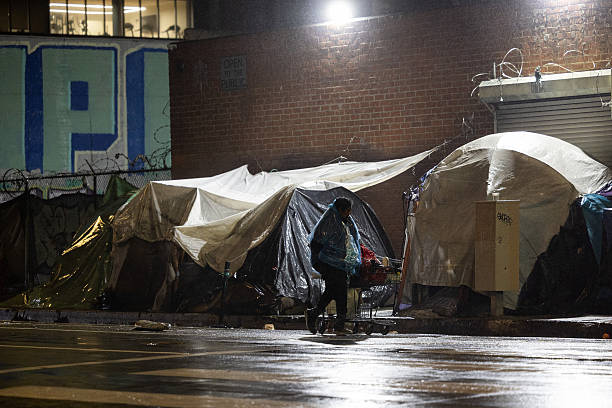
For years, the common and quasi accepted locale for sidewalk living without tents or shelter for men and women encamped on sidewalks was Skid Row and other parts of Downtown L.A.. That’s changed. Men and women encamped on sidewalks are now seemingly everywhere in the city. The result- cities are now in a frantic rush to remove sidewalk tents, shelters, and entire encampment from public space.
Los Angeles is among those cities. It and other cities have the law and public pressure to act on their side. In June 2024, the U.S. Supreme Court virtually gave cities and counties the license to sweep the streets of homeless men and women without providing places for them to live or services to keep them off the streets. The court ruled that cities could fine sidewalk sleepers and at the same time were under no obligation to find housing for them.
That also gave city officials the license to ban clusters of street encampments without providing any housing placement substitute.
The Supreme Court went even further and rejected the notion that it was “cruel and unusual punishment” to punish people for sleeping on the sidewalks. The reaction from homeless support advocates was swift and angry.
Many business owners, residents, and commuters have stepped up demands that Los Angeles officials act. They repeatedly cite tents and other makeshift shelters as health and safety menaces. The Los Angeles sanitation department said it gets thousands of requests monthly to get rid of the tents and encampments.
Homeless rights advocate groups have pushed back. “We are seeing an increase in these laws at the state and local level that criminalize homelessness, and it’s really a misguided reaction to this homelessness crisis,” said Scout Katovich, a staff attorney with the American Civil Liberties Union. It has filed lawsuits challenging the constitutionality of sweeps and property seizures in a dozen cities including Los Angeles.
“These laws and these practices of enforcement do nothing to actually alleviate the crisis and instead they keep people in this vicious cycle of poverty,” she further noted.
The problem with the enforced removal of encampments and sidewalk tents is what to do with the occupants? In fact, the “where do they go “question has been the perennial question asked every time cities make periodic sweeps of homeless encampments. The sweeps amount to little more than rearranging the deck chairs on the Titanic. It is simply shifting them from one part of the city to another, maybe placing a few in temporary shelters, while leaving the rest right back where they started, plopped down on yet another sidewalk.
Though residents have mostly reacted with glances and shrugs, the growing number of those sidewalk dwellers present a clear and present safety, health and welfare hazard to nearby residents and business owners. They are more than an eyesore. They evoke fear and anxiety of the potential hazard their presence brings to residential neighborhoods.
That fear is heightened by the fact that the overwhelming majority of these men are African American. And they are for the most part young.
Many admittedly do have chronic mental and physical challenges, which are a major reason why they landed on the streets. That presents an even greater challenge for city and county officials trying to come up with a workable plan to remove them from the sidewalks but do so in a safe and humane way.
Los Angeles city officials have spent tens of millions of dollars on the removal of encampments. They have spent tens of millions more on building, renting, leasing temporary and transitional housing for the homeless. They have spent tens of millions more in ramping up drug, alcohol, and mental health treatment and counseling for homeless individuals. These are crucial and much needed ongoing measures to combat the homeless crisis in the city.
However, these measures fall flat in addressing the new norm of the men and women who make their homes on the bare sidewalk concrete.
L.A. city officials have not totally rushed head long to toss unhoused men and women back on the sidewalks—tentless. They have chosen not to criminalize those on the sidewalks. These individuals need help and support, not a jail cell. The goal must be to do everything possible to see that they get that help.
Written By Earl Ofari Hutchinson
One can find more info about Mr. Hutchinson over at the following site; TheHutchinson Report.
Also feel free to connect with him through twitter; http://twitter.com/earlhutchins
He is also an associate editor of New America Media. His forthcoming book is From King to Obama: Witness to a Turbulent History (Middle Passage Press).
