
(ThyBlackMan.com) For many Black Americans, Muhammad Ali was never just a boxer. He was a warning, a lesson, a mirror, and in many ways, a permission slip. He gave voice to thoughts many of our parents and grandparents carried quietly in their chests. He stood in public the way a lot of us were taught to stand in private. Unapologetic. Certain. Unmoved by white approval or comfort.
Ali understood something early that many Black men learn late, if at all. If you wait for this country to give you permission to be yourself, you will die waiting. His words were not crafted for posters or classrooms. They came from pressure, from surveillance, from punishment, from sacrifice. That is why they still land with weight today.
These nine quotes are not just inspirational sayings. They are cultural markers. They speak to Black struggle, Black pride, Black discipline, Black faith, and Black self definition in ways that still feel painfully current.
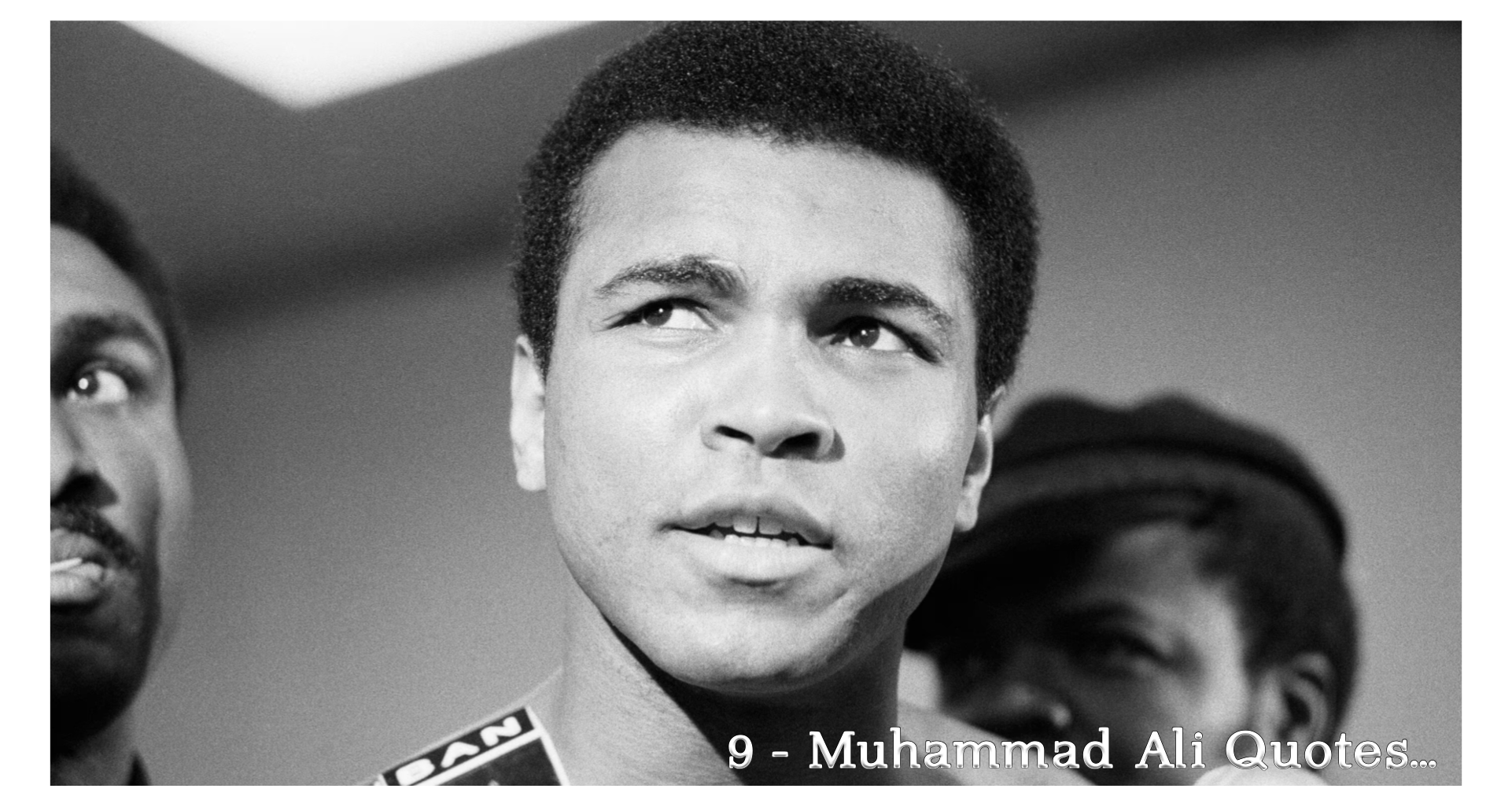
1. “He who is not courageous enough to take risks will accomplish nothing in life.”
As a Black man in America, risk has never felt optional to me. Even surviving comes with consequences. I learned early that fear is already built into the system, so living cautiously does not guarantee safety. All it really guarantees is smallness. Playing it safe does not protect us from scrutiny or punishment. It only makes us easier to overlook.
This hits home for me because I have heard my whole life that we should be patient, wait our turn, keep our heads down, and not rock the boat. That advice is often given out of love, but history shows it rarely protects us. Ali ignored that guidance publicly and paid for it with titles, money, and years he never got back. Still, I believe the real loss would have been silence. Watching his life unfold taught me that dignity costs something, but silence costs more.
I still wrestle with this today. Do I speak up at work and risk being labeled difficult or aggressive, or do I stay quiet and feel myself shrinking? Do I tell the truth when it is uncomfortable, or do I protect someone else’s peace at the expense of my own? Ali reminds me that risk is not recklessness. It is clarity. It is choosing growth over approval.
Nothing meaningful has ever been handed to Black people without pressure. Every gain came because someone accepted the cost of standing out. When I sit with Ali’s words, I am reminded that courage is not optional if I want more than survival. It is the price of self respect.
2. “I hated every minute of training, but I said, ‘Don’t quit. Suffer now and live the rest of your life as a champion.’”
This speaks directly to the kind of discipline I was raised to understand. The kind that does not get celebrated or filmed. Ali was honest about the pain. He did not pretend the work was glamorous. He admitted that it hurt and still committed to it. That honesty resonates with me.
As a Black American, the grind feels familiar. We are often taught that we have to work twice as hard for half the recognition, and sometimes none at all. That exhaustion did not start with us. It was passed down. Ali did not deny that reality. Instead, he reframed it. He treated suffering as temporary and purposeful rather than endless and imposed.
The pain was never the point. Endurance was. Ali chose short term discomfort over long term regret, and that mindset echoes what I watched in my own household. Parents sacrificing rest, comfort, and ease so their children could stand a little taller and walk a little freer. That kind of sacrifice rarely makes headlines, but it builds foundations.
This reminds me that discipline is not about motivation. It is about commitment. I show up even when I hate it because quitting costs more than pain ever could. Pain fades. Regret stays.
3. “Age is whatever you think it is. You are as old as you think you are.”
I have never accepted the idea that the world gets to decide when I am finished. For Black men especially, age has often been used as a quiet dismissal. Too young to be taken seriously. Too old to matter. Too late to change direction. Ali rejected all of that, and so do I.
This challenges the lie that growth has an expiration date. I feel the pressure to figure everything out early because I know society does not always offer us grace later. Mistakes stick longer. Second chances come slower. Ali’s words push back against that anxiety and remind me that time does not erase purpose.
Even as his body slowed, Ali’s authority grew. Watching that taught me that strength is not only physical. Wisdom deepens. Presence sharpens. Dignity matures. Those are forms of power no one can take away.
This encourages me to see aging not as loss, but as layering. Each year adds perspective I could not have earned any other way. Ali’s life showed me that relevance is not assigned by numbers, but by intention. I am not done simply because someone else is done with me.
4. “I don’t have to be what you want me to be.”
This feels deeply personal to me. From the beginning, Black people in America have been told who we are allowed to be. The entertainer. The athlete. The worker. The symbol. Rarely the full human being with contradictions, complexity, and autonomy.
Ali refused to perform gratitude or obedience, and I understand why. He refused to soften his voice to make others comfortable, and I have felt the pressure to do exactly that. Shrinking yourself to fit someone else’s expectations is a slow kind of erasure.
I still navigate spaces where authenticity feels dangerous. Code switching is not a preference for me. It is a skill learned for survival. There are rooms where telling the truth costs opportunity, and Ali knew that reality long before many of us could name it.
This stands as a declaration of self ownership for me. I do not owe the world a version of myself designed for its comfort. Ali showed me that freedom begins the moment I stop asking permission to exist fully.
5. “Hating people because of their color is wrong. And it doesn’t matter which color does the hating. It’s just plain wrong.”
When I sit with this, I hear moral clarity, not convenience. Ali was not speaking to win points or soften realities. He was speaking from a place of hard-earned understanding. As a Black man, I know what it feels like to carry anger that did not start with me. I also know how easy it is for that anger to harden into something that quietly reshapes how you see everyone around you.
Ali never denied power or structural reality. Neither do I. Racism has teeth. It shows up in laws, institutions, economic barriers, and daily interactions. It leaves scars on bodies and minds. But Ali was drawing a line between confronting injustice and allowing hatred to take root inside you. I have watched people with every right to be angry become trapped by that anger, unable to rest, unable to trust, unable to heal.
What this forces me to confront is whether my struggle is rooted in dignity or dominance. Ali chose dignity. He refused to let racism turn him into something smaller, colder, or crueler than he already had to be. That kind of restraint is not weakness. It requires discipline. It requires a sense of self that is not dependent on revenge for validation.
In a time when racial conversations are often reduced to shouting matches and online performance, Ali’s words steady me. They remind me that freedom is not about mirroring the harm we received. It is about refusing to let hatred decide who we become in the end.
6. “To be able to give away riches is mandatory if you wish to possess them. This is the only way that you will be truly rich.”
I grew up understanding that wealth was not just about money. It was about who showed up when things got tight. Who shared when resources were thin. Who made sure nobody was left behind if they could help it. Ali spoke from that same foundation. He understood that money without generosity is hollow.
When I reflect on this, I think about how American culture encourages hoarding. Stack what you can. Protect it. Guard it. Separate yourself. Ali rejected that logic completely. To him, possession without purpose was insecurity pretending to be success. Giving was not charity. It was proof that you were not controlled by what you owned.
This resonates deeply for me because Black survival has always depended on circulation. From church envelopes passed quietly down rows, to borrowed rides, shared meals, and emergency help that never made the news, we endured because somebody gave even when it was inconvenient. Ali honored that truth by living it publicly.
What this reminds me is that legacy is not built by accumulation. It is built by impact. What I give away tells the real story of my values. Ali understood that real wealth leaves fingerprints on other people’s lives long after the money is gone.
7. “Life is so, so short. Bible says it’s like a vapor.”
This hits me in the chest every time. Ali understood how fleeting everything is. Fame fades. Bodies break. Applause stops. I feel that urgency too, especially as a Black man watching how quickly life can be interrupted without warning or explanation.
Faith has always been both shelter and strength in our community. It was never about passivity or escape. It was about endurance and grounding. Ali’s belief did not make him quiet. It made him fearless. When you truly accept how brief life is, fear loses its leverage over you.
I take this as a reminder not to postpone my truth. Too many people wait for the right time, the right approval, or the right conditions that never come. Ali did not live that way. He moved with urgency, but not panic. With intention, not anxiety.
This pushes me to speak while I have breath. To stand while I have strength. To love honestly while time allows it. If life really is that fleeting, then what I choose to do with my moments matters more than comfort ever could.
8. “All black Americans have slave names. They have white names; names that the slave master has given to them.”
This forces me to sit with the weight of identity in an uncomfortable but necessary way. Names are not neutral. They carry memory, ownership, and erasure. Ali understood that deeply. When he rejected his birth name, he was not rejecting his parents or his upbringing. He was rejecting a system that assigned identity without consent.
I see this as an act of psychological freedom. Answering to a name tied to ownership is not just about sound or tradition. It is about inheritance and power. Ali refused to carry that weight silently, and that refusal unsettled people because it exposed how normalized that history had become.
Even now, this still stirs discomfort because it goes to the root of who gets to define us. Who names you shapes how you see yourself. Who you answer to shapes how you move through the world. Ali chose himself, publicly and without apology.
What this reminds me is that liberation is not only external. It is internal. It lives in how we see ourselves and what we accept as truth. Naming yourself is an act of power, and Ali claimed that power fully.
9. “I had to prove you could be a new kind of black man. I had to show the world.”
When I read this, I feel the weight Ali carried. He knew he was never just representing himself. He was pushing against a narrow script written long before he arrived. He understood that visibility creates permission, whether he wanted that responsibility or not.
Ali showed the world a Black man who was loud, thoughtful, spiritual, defiant, compassionate, and unapologetic all at once. He refused to flatten himself to be accepted. Watching him made me realize that complexity itself can be a form of resistance.
For generations of us, Ali cracked the door open. He made room to exist beyond stereotypes that shrink us and box us in. He showed that confidence is not arrogance and that pride is not criminal. He allowed us to imagine ourselves more fully.
What lasts is not just what Ali achieved, but what he expanded. He widened the definition of Black manhood simply by being himself without apology. That kind of legacy does not fade. It keeps breathing through everyone who chooses to stand fully in who they are.
Muhammad Ali did not just speak to his time. He spoke for ours. His words remain relevant because the struggles they address never fully disappeared.
For Black Americans, Ali is not just a legend. He is a reminder of what it looks like to stand tall without permission.
