
(ThyBlackMan.com) I am built differently. Cats of my generation are built differently, too. We came out of the mud, with no seatbelts required in cars and no helmets required to ride a bike. We were the four-square, stickball, and marble-playing generation, where every boy took a spinning top to class each day in elementary school. Compared to current standards, that was who we were.
To make it more provident and divinatory, I had a girlfriend in college whom I loved to death. Monique Williams. For some reason, she lacked the reason, providence, and judgment to recognize that her world of make-believe was not mine. In her head, regardless of all other attributes, she considered me a thug and a gangster, which could not be farther from the truth. All because I chewed tobacco, toted a gat daily, and felt no reluctance to shoot a mutha fuca if I had to. I was merely the average run-of-the-mill country boy; I wasn’t from the streets. She lost her mind that time I shot at a dude trying run me off the road. We broke up after that. I loved slim, Jesus wept.
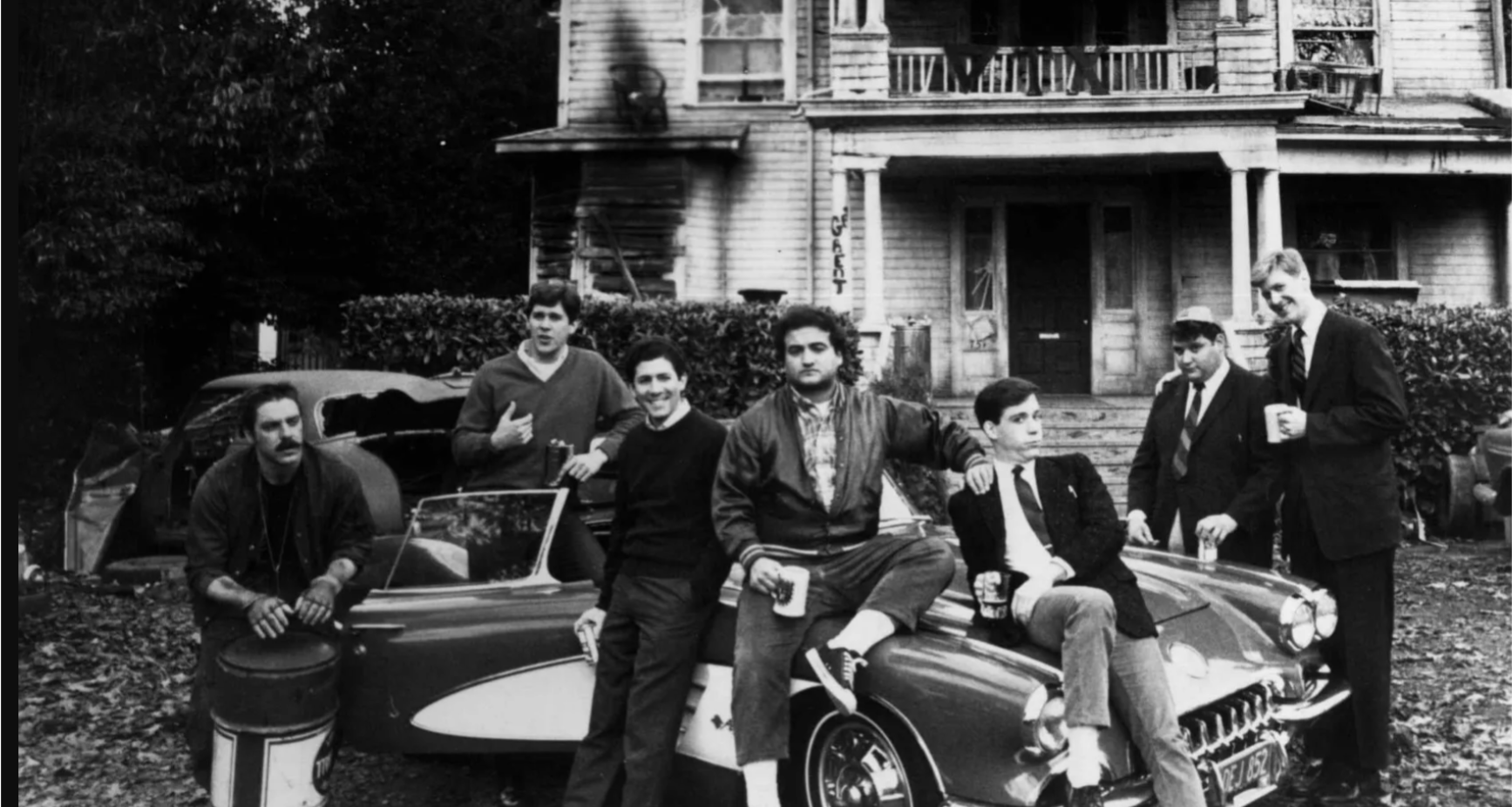
True, I ran with other country cats. Dice shooting, pick-up truck, and Cadillac driving, musician, weed smoker, drug dealers, and dudes that fought dogs. Ain’t proud of it, but Doris Day. I also had a pool in my backyard, gave parties, and was quick to pick up a broad like Harpo Marx. Every Friday you could catch us at Club No Name (real name), drinking Vat 69 and gangsta walkin’ to DJ Spanish Fly amidst the smell and smoke of chicken head and scunion in the air. Don’t reckon another generation like ours will be proofed in 12-year-old Oak barrels like we were by age 16, for we were the last of the Animal House generation.
Animal House (1978) is a classic raunchy comedy set at the fictional Faber College in the early 1960s. The story follows a group of misfit students who pledge Delta Tau Chi, a notoriously wild and irresponsible fraternity known for nonstop partying, pranks, and total disregard for authority.
When the college administration, led by the uptight Dean Wormer, puts Delta on double-secret probation, the fraternity responds by escalating its rebellion rather than cleaning up its act. Meanwhile, rival frat Omega Theta Pi, made up of elitist, well-connected students, works closely with the dean to get Delta shut down for good.
As tensions rise, Delta’s antics grow more outrageous, culminating in a chaotic homecoming parade that turns into full-blown campus mayhem. Despite the fraternity eventually being expelled, the film ends by revealing that most of the Delta members go on to surprisingly successful (and ironic) futures.
At its core, Animal House is a satirical take on authority, conformity, and youth rebellion, using crude humor and absurdity to mock the rigid social structures of college life and 1960s respectability. It was followed by a few more movies [The Warriors-1979, Friday the Thirteenth and The Blues Brothers-1980], and many more that probably couldn’t be made today.
Me and mine were Animal House before the movie came out, during my 10th-grade year. If the Barbary pirates had not existed, we would have been them. We were the Memphis version of the Barbary corsairs. These North African seafaring raiders operated from roughly the 1500s to the early 1800s out of ports along modern-day Morocco, Algeria, Tunisia, and Libya (the Barbary Coast). Sadly, we were foul like that. Shout out to Tripoli.
Point blank period, when people ask me what kind of movie Animal House is, I tell them it’s a documentary. When I was at Morehouse, every room had the Animal House poster that said ‘We can do anything we want to… we’re college students,’ or the American Gigolo poster.
The movie justified the hard drinking my friends and I did in high school, and introduced me to the toga party, which we would come to call LAGNAFs (Let’s All Get Naked And………).
“Fat, drunk, and stupid is no way to go through life, son,” is a classic line, and I love how, when he pauses after saying “When the Going Gets Tough,” the music goes into a holding pattern too. John Belushi is brilliant as Bluto Blutarsky.
Animal House sounds like an educational children’s TV show that teaches children about all sorts of animals and what makes them special. But it wasn’t, it was more than that. It was a rite of passage and reflective of a time when you got a daily morning and evening paper delivered to your house, and when Supreme Court Jurists knew what a woman was, didn’t perform in Broadway plays, or attend the Grammys. It was a period when chopping off a child’s breast or penis was a disgusting thought to even consider, let alone imagine being carried out.
Since then, I have managed to mature into the person I am, and I thank Animal House, in concert with the “Droogs” (Hat tip to Anthony Burgess’s A Clockwork Orange, 1962), for coming up with. Many, unfortunately, were dead before age 35, with many of the remaining ones being functional alcoholics, players, fathers, husbands, or an amalgam of all the aforementioned. Animal House brought to my attention that, although I wrote poetry, I was an essayist more than a poet.
From my perspective, if Animal House were an essay, its core purpose would be to mock and critique authority, conformity, and moral pretension, which is exactly what I do daily. I would say that the thesis (implied, not stated) is that institutions that claim moral superiority (elite universities, fraternities, administrators, politicians, or journalists) are often hypocritical, arbitrary, and disconnected from real human behavior.
Instead of logic and citations, the film uses exaggeration, absurdity, and inversion (the “worst” students are the most human; the “best” students are cruel, empty, or authoritarian). To me, it is the classic satirical argument in film form: it doesn’t tell you what to think, it makes the official values look ridiculous until they collapse on their own. Something my readers may notice I do frequently.
Structurally, Animal House also works like a narrative essay. Not only does it follow a chronological arc and makes uses specific characters as case studies, but it also shows rather than tells how power works in social systems.
Its power comes from undermining seriousness with comedy, not from formal reasoning, and that satirical narrative argument that critiques institutional authority and moral hierarchy by dramatizing the conflict between lived human behavior and imposed social order is the primal battle imbued in living and enjoying life.
So for the good times, “Can we dance with your dates?” Harold Ramis was a genius. R.I.P.
Staff Writer; Torrance T. Stephens
Can also purchase any of his books over at; Amazon – TTS Books.
