(ThyBlackMan.com) Hip hop has always been political whether it wanted to be or not. From its earliest days in the Bronx, the culture spoke truth to power, chronicled poverty, resisted authority, and gave voice to communities ignored by mainstream America. Even when the music leaned toward escapism, the backdrop was always real. So when one of hip hop’s most visible and influential figures stands on a federal stage and calls herself Donald Trump’s “No. 1 fan,” the reaction is not just shock. It is grief, confusion, anger, and a deep sense that something sacred has been broken.
Nicki Minaj’s declaration did not come from a casual interview or a passing comment on social media. It came at a Treasury Department hosted summit in Washington, an event designed to promote so called “Trump Accounts” for newborn babies. Standing before a crowd of political allies and supporters, Minaj embraced the moment fully, dismissing critics and framing her support for Trump as both righteous and divinely protected.
“I will say that I am probably the president’s No. 1 fan,” she told the audience. “And that’s not going to change.”
For many in hip hop, particularly Black listeners who grew up viewing rap as a counter narrative to state power, those words landed like a betrayal. This was not just a celebrity expressing a political opinion. This was a cultural icon aligning herself with a political figure whose policies and rhetoric have consistently harmed the very communities that helped build her career.
Minaj went further, portraying herself as a victim of “hate” and “bullying,” framing opposition to Trump not as political disagreement but as unfair persecution.
“The hate or what people have to say, it does not affect me at all,” she said. “It actually motivates me to support him more.”
That framing matters. It mirrors the language used by Trump himself, who often casts accountability, criticism, and protest as persecution. In adopting that posture, Minaj did more than endorse a president. She adopted his worldview.
This is where the conversation stops being about individual politics and starts becoming about cultural responsibility.
Nicki Minaj did not always stand here. In 2020, she publicly stated that she would not “jump on the Donald Trump bandwagon.” At the time, she positioned herself as independent, skeptical, and unwilling to be used as a political prop. Many fans respected that stance, even if they did not always agree with her takes. There was at least an understanding that she was weighing her platform carefully.
That restraint is gone.
In recent years, Minaj has increasingly aligned herself with right wing spaces, culminating in her surprise appearance at Turning Point USA’s annual conference. There, she praised Trump in glowing terms, describing him as a symbol of hope and integrity.
“I have the utmost respect and admiration for our president,” she said. “He’s given so many people hope that there’s a chance to beat the bad guys and to win and to do it with your head held high.”
That language raised eyebrows long before the Treasury Department appearance. Turning Point USA is not a neutral political organization. It is a hard right group known for opposing racial justice initiatives, promoting anti Black narratives about crime and culture, and attacking movements that hip hop historically aligned with. For Minaj to not only attend but praise Trump in that space signaled a deeper shift.
Her justification leaned heavily on personal identification. Trump is from Queens. She is from Queens. That shared geography was presented as a bond, as if birthplace could override policy, history, and consequence.
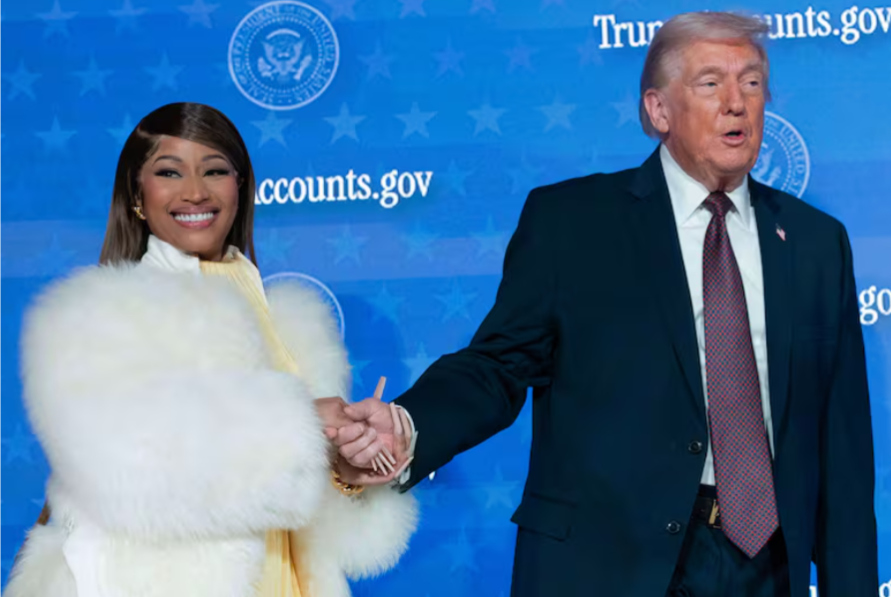
At the Washington event, Donald Trump returned the praise enthusiastically. He called Minaj the “greatest and most successful female rapper in history,” thanked her for donating hundreds of thousands of dollars to the Trump Accounts initiative, and joked about her long painted nails while holding her hand.
“I just think she’s great,” Trump said.
The imagery alone unsettled many observers. A billionaire former president, whose administration pursued policies that disproportionately harmed Black communities, physically clasping hands with a rap icon whose success was built on Black women’s support, while joking about aesthetics. It felt symbolic in a way that was hard to ignore.
Trump even acknowledged the tension, noting that Minaj had taken heat because “her community isn’t necessarily a Trump fan.” That phrasing was telling. It reduced a broad range of political objections to mere fandom, as if opposition were irrational rather than rooted in lived experience.
This is where the backlash intensified.
For many fans, critics, and hip hop historians, Nicki Minaj’s embrace of Trump feels like a sellout not because she holds a different opinion, but because of how she holds it. There is no acknowledgment of harm. No grappling with Donald Trump’s record on race, immigration, policing, voting rights, or economic inequality. Instead, critics are framed as bullies. Trump is framed as a victim. God is invoked as a shield against accountability.
That framing has consequences.
Some of the harshest reactions online have used language that reflects deep disappointment and anger. Words that are painful, historically loaded, and emotionally charged have surfaced in conversations about Minaj’s political turn. Many people are not just asking whether she supports Trump. They are asking whether she has abandoned the collective consciousness that hip hop once demanded from its leaders.
When people ask “what happened to hip hop,” they are not being nostalgic for a golden age that never existed. They are pointing to a real shift in values. Hip hop once prided itself on being oppositional, skeptical of power, aligned with the marginalized. Now, some of its biggest stars appear eager to be embraced by the very institutions the culture once challenged.
Nicki Minaj’s defenders argue that she has the right to her political beliefs. That is true. But rights do not exist in a vacuum. Influence carries responsibility. When someone with her reach speaks, it reverberates beyond personal preference. It shapes narratives. It legitimizes power structures. It sends signals about what is acceptable and what is aspirational.
Minaj has positioned herself as fearless, unbothered, motivated by opposition. But critics argue that what she calls bravery looks more like comfort with power. Supporting Trump in elite political spaces is not rebellion. It is alignment with authority.
There is also the question of money. Trump publicly thanked Minaj for donating hundreds of thousands of dollars to the Trump Accounts initiative. That detail matters. Political support backed by significant financial contribution moves beyond symbolism. It becomes material endorsement.
For fans struggling with healthcare access, housing instability, student debt, and systemic discrimination, watching a wealthy entertainer funnel money into a political project tied to an administration that has rolled back protections feels like salt in a wound.
Some have asked whether Minaj is an undercover MAGA figure, whether this support has been quietly building behind the scenes. Others argue that it is not undercover at all anymore. It is overt, unapologetic, and deliberately provocative.
Minaj herself seems to relish the provocation. By framing criticism as bullying and hatred, she positions herself as the brave truth teller standing against an unreasonable mob. That narrative mirrors a broader trend among celebrities who align with right wing politics while claiming persecution despite their wealth and influence.
What is missing from Minaj’s statements is any serious engagement with the substance of Trump’s presidency. There is no discussion of policy. No acknowledgment of the communities harmed. No reflection on the role hip hop has historically played in resisting exactly this kind of power.
Instead, the conversation becomes about loyalty, fandom, and vibes.
That shift is not accidental. It reflects a broader transformation in hip hop’s relationship to capitalism and celebrity. As the genre has become more profitable and mainstream, its ties to radical critique have weakened. For some artists, proximity to power now feels safer than opposition to it.
Nicki Minaj’s career arc embodies that contradiction. She is undeniably talented, influential, and historically significant. She shattered barriers for women in rap and built a global brand. But with that success has come a growing distance from the grassroots communities that once fueled hip hop’s soul.
The anger directed at her is not just about Trump. It is about a feeling that hip hop’s elders and icons are abandoning the values they once benefited from. That they are using the language of empowerment while standing beside figures who undermine collective liberation.
The question “should we stop supporting her” reflects a deeper dilemma. Can fans separate art from politics when the artist uses their platform to legitimize harmful power? Is continued support complicity, or can it coexist with criticism?
Hip hop has faced this question before, but rarely with such stark symbolism.
Nicki Minaj did not simply endorse a candidate. She stood on a federal stage, invoked God’s protection over a president, dismissed critics as bullies, and accepted praise and physical familiarity from one of the most divisive political figures of the modern era.
For many, that crossed a line.
What happens next will shape how this moment is remembered. Will Minaj engage with the substance of the criticism, or continue to dismiss it as hate? Will hip hop artists speak out, or remain silent out of fear or convenience? Will fans demand accountability, or normalize alignment with power as just another personal choice?
Hip hop is at a crossroads. It can continue drifting toward elite validation and political opportunism, or it can reclaim its tradition of critical engagement and collective responsibility.
Nicki Minaj has made her choice clear.
Now the culture must decide what that choice means, and whether it is willing to accept it as the new normal.
Staff Writer; L.L. McKenna
Politics explained through the lens of justice and equity. Offering perspective that informs, challenges, and empowers.
One can contact this brother at; LLMcKenna@ThyBlackMan.com.
