
(ThyBlackMan.com) Criticism of policies advanced by the government of Benjamin Netanyahu can be socially and politically sensitive in the United States. Some observers note that public criticism of Israeli leadership may be interpreted by others as antisemitic, given the long and painful global history of antisemitism. This concern often leads private citizens (such as myself) and public figures to choose their words carefully so that their opposition to specific Israeli government policies would not be perceived as prejudice toward Jewish people.
Additionally, many American Christians (myself included) feel a strong religious connection to Israel rooted in biblical teachings regarding the Holy Land. These theological beliefs contribute to strong political support for Israel across segments of the American population. These religious and historical dynamics can also make debate about Israeli policy particularly complex and emotionally charged.
This op-ed focuses exclusively on questions of political influence, diplomacy, and U.S. foreign policy decision-making. It critiques political leadership and public policy decisions only. It does not express hostility toward Jewish people, Judaism, or the legitimacy of the State of Israel. In fact, I have previously written an article in support of Jewish Americans and the State of Israel, “The Jewish Community Has Consistently Been A Supporter Of The Black Struggle,” which highlights the historic role that Jewish individuals and organizations have played in advancing civil rights alongside African American leaders.
A New Dimension: The War With Iran
The debate over whether Donald Trump is overly aligned with Netanyahu and Vladimir Putin has taken on renewed urgency following the current war involving the United States, Israel, and Iran. According to reporting, the conflict began after joint U.S.–Israeli strikes triggered retaliation by Iran, expanding into a broader regional conflict affecting global energy markets and international alliances. Statements from Secretary of State Marco Rubio have further intensified debate about the extent of Israeli influence on U.S. decision-making. Rubio told reporters that U.S. officials were aware Israel was planning military action against Iran and that American forces acted preemptively because retaliation could target U.S. personnel in the region: “We knew that there was going to be an Israeli action… and we knew that if we didn’t preemptively go after them… we would suffer higher casualties.”
Some analysts interpret Rubio’s remarks as evidence that Israeli military planning played a significant role in shaping U.S. timing and strategy in the conflict. Subsequent statements from Rubio attempted to clarify that the United States was not “dragged” into war but made its own strategic determination that military action was necessary. Nevertheless, debate continues regarding whether U.S. involvement reflected independent strategic priorities or alignment with Netanyahu’s objectives against Iran. The war has already had far-reaching geopolitical consequences, including strain within NATO and tensions with European allies who have hesitated to provide military support.
Netanyahu, Strategic Alignment, and the Question of Influence
Trump’s relationship with Netanyahu has long been characterized by visible personal rapport and policy alignment. Understanding Trump’s propensity for praise, Netanyahu consistently compliments Trump. Netanyahu stated that Trump is, “the greatest friend that Israel has ever had in the White House.” He also described Trump as, “a great leader for America and the world.” Regarding his proposals concerning the Middle East security, Netanyahu describes some Trump’s initiatives as “fresh ideas” capable of achieving Israeli strategic objectives.
Supporters argue this cooperation reflects longstanding U.S. commitment to Israel’s security. Critics argue that the Iran conflict illustrates how Israeli security priorities may influence U.S. military engagement decisions. The question is not whether the United States and Israel share interests — they clearly do — but whether policy decisions are being shaped primarily by U.S. strategic needs or by the political priorities of Israeli leadership.
As previously stated, the sensitivity surrounding criticism of Israeli policy further complicates the debate. Policymakers often proceed cautiously when questioning Israeli leadership, aware that criticism can be interpreted as hostility toward Jewish people rather than disagreement over policy decisions. At the same time, religious connections to Israel among American Christians contribute to strong political support for Israeli government positions, reinforcing bipartisan reluctance to publicly challenge Israeli leadership.
Trump and Putin: A Parallel Concern
During the final 2016 presidential debate, Clinton raised concerns about Trump’s relationship with Russia, stating that Putin, “would rather have a puppet as president of the United States.” Trump rejected the characterization, responding, “No puppet, no puppet. You’re the puppet!” Clinton elaborated that Trump appeared willing to “spout the Putin line… break up NATO, do whatever he wants.” Her argument reflected broader concerns among national security officials that Russia sought to influence democratic elections and weaken Western alliances.
Trump has frequently praised Putin’s leadership style. And Putin has expressed praise for Trump, stating that Trump is a “very talented person… undoubtedly bright.” And that Trump is “an intelligent person… quite experienced.”
During the 2024 presidential campaign Kamala Harris argued that Trump’s rhetoric toward Putin represents an unprecedented posture for an American president. “No previous U.S. president, regardless of their party, has bowed down to a Russian dictator before.” During the presidential debate. Harris told Trump, “These dictators and autocrats are rooting for you again to be president… they manipulate you with flattery and favors.”
Why the Question Matters?
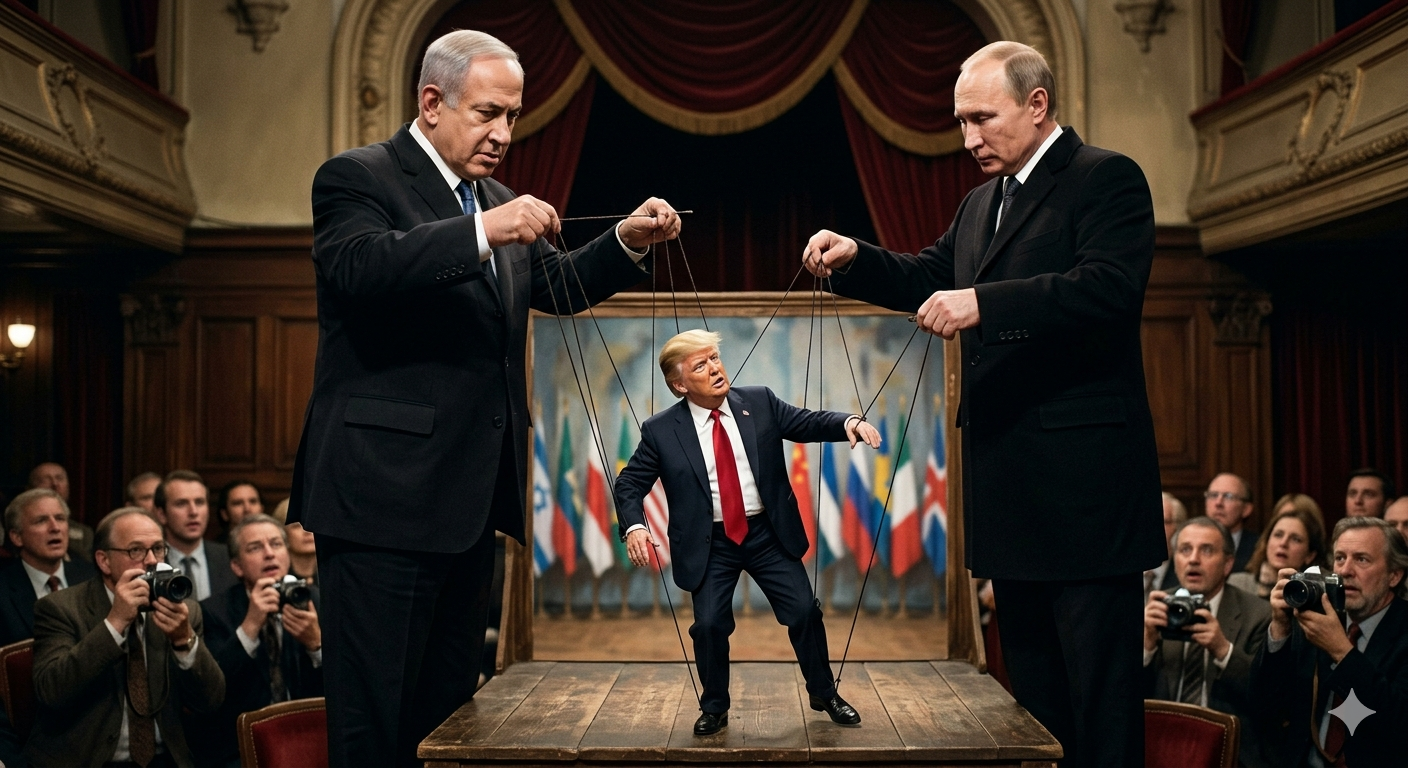
The central question emerging from these concerns remains: Do Trump’s statements and policy positions reflect independent strategic calculation, or do they align so consistently with the interests of foreign leaders that concerns about influence become unavoidable? Presidents inevitably develop working relationships with foreign leaders. Diplomatic engagement requires negotiation and cooperation. However, when major policy decisions — including military action — appear closely aligned with the preferences of foreign governments, questions about influence naturally arise.
The Iran war has increased debate about whether U.S. foreign policy decisions are fully independent or shaped by the strategic goals of Israel and Moscow. This debate has intensified because the war has produced mixed geopolitical effects that some analysts argue benefit both Israel and Russia while imposing costs on the United States. Israel has weakened a key regional rival through coordinated U.S.–Israeli strikes that significantly degraded Iran’s missile and military infrastructure, strengthening Israel’s strategic position in the Middle East. Russia, meanwhile, has benefited economically from rising global energy prices and geopolitical distraction that shifts U.S. attention away from Ukraine, while also expanding its influence through intelligence cooperation with Iran. The United States, however, faces higher military expenditures, increased global instability, strained alliances, and disruptions in energy markets, higher gas prices and global trade, all of which increase economic cost for families and political costs for Washington. As a result, some analysts conclude the conflict has strengthened Israel’s security posture and created strategic opportunities for Russia, while exposing the U.S. to financial burdens, the possibility of a recession, and diplomatic challenges associated with a prolonged regional war.
Thus the Central Question Persists
Is Donald Trump pursuing an unconventional but independent foreign policy strategy? Or do repeated patterns of alignment with Netanyahu and Putin suggest that U.S. decision-making may be influenced by external political interests? Who’s pulling the strings? The answer to that question carries significant implications not only for current conflicts, but for the future direction of American global leadership. As geopolitical tensions continue to evolve, voters and policymakers alike will continue to examine how personal diplomacy, alliance politics, and strategic interests intersect in shaping U.S. foreign policy.
RJW is a retired Professor of Education. He is a prolific writer and the author of 12 Characteristics of an Effective Teacher.
